
Top tip or tips. Tech Talk and Tech Tips plus a tip for better boating.
This area of tip or top tips is going to be growing gradually over the next few years so keep a watch on this area.
Boat Tip No 1
Bilge Pumps
While looking into this very important area we have come across a few different types of pump. They fall into the categories of three switch position and two position operated electrical pumps. Your pump should be the automatic type which will operate on its own if it detects water in the bilge.
The three position pump allows you to turn it fully off, (not advised) to be left in automatic mode, and manual operation which overrides the automatic feature on a temporary basis. This is obviously the best version to get. However must have a three way toggle switch with the last position as press to keep on as the manual position.
The two position version is either off or in automatic mode. This pump will run for a short while, to pump out; when it detects water then turns itself off for a short period of time. It then automatically resumes pumping again, turning itself on and off until the water is removed. This helps with keeping it cool and not burning out.
It is important to check your pump every so often if not used for long periods. Never run these pumps without any water for even the shortest period as this can damage them.
Boat Tip No 2
Bow Thrusters
This a really complex subject seeing that the solution is so simple. There are mainly two types of bow thruster, the electrically powered unit and a hydraulically powered unit.
The electrically powered version is the most common as it is cheaper and relatively easy to fit. The other hydraulically powered is much dearer and you require a lot of fitting and special hydraulic pumps and controls.
Requirements
The boat will need a bow thruster tube regardless of which type of thruster you put on unless you go for a hydraulic pod. The pods are susceptible to damage and you need two. These are not ideal for canal work, in my opinion the bow thruster tube is a very nice option. We were lucky as our boat manufacturer Collingwood, had pre-fitted one for us, but not installed the unit. We had to sort out correct tube diameters so we had the correct propeller size and motor. I elected for a Craftsman electric bow thruster, but there are many on the market.
The next thing you need to look at is battery sizes. If you look at the thruster specifications you will see the battery load for each type. Mine required a minimum of 120 amp/hour supply. This is the rating that is fed to the motor when in use.
You then have to ensure that you have the correct length of control lead and charging leads. I researched on how to charge the bow thruster battery and came up with a brilliant idea called a combiner. This made by Victron; it is a 12v / 24v 120A Victron Cyrix-ct Voltage Sensitive Relay, this allows you to combine the starter motor battery with the thruster battery. So when the starter battery is full it charges the other one. This unit has a nice feature. It allows you to fit a press switch which only makes contact and does not switch on permanently to be installed, which allows you to have a 30 second period of emergency start from the bow thruster battery to the engine starter motor. There are larger units for larger loads.
With the hydraulically powered units you require an add on to your engine, which is a hydraulically pump that supplies the thruster unit with hydraulic oil to power the thruster unit. In addition you need the hydraulic control unit, high pressure hydraulic pipes and fittings, plus of course special oil to run it. Fitting this type is very expensive, nearly four times as much as the electrically drive units. Mine cost be about £1900.00 all in and working, including fitting.
Pros can cons
The electrically powered unit is cheap and easy to maintain and setup, plus locate the controls. However on average you can only use them in short bursts. They have a working time of say two full minutes in every hour due to the motor getting hot.
Hydraulically powered have no time limit for use, however cost a lot to install. The control units can be a bit bulky and the pumps very expensive. To give you an idea of a canal line 42 power pump, it will cost you £500 before looking at the rest of it. I estimates a total cost of around £3500.00 ex fitting.
Boat Tip No 3
Solar Panels
Having had a few enquiries regarding solar panels, like are they worth it? Here is a small discussion about them. They are worth it if you are a live aboard or an occasional boater. The cost is a little high but in general the systems are getting cheaper and smaller, and also better at converting solar energy into electrical power. See our Fitting a solar panel page.
Solar panels are certainly of help to you when you winterize your boat, as the batteries are kept topped up for free, without having to have a shore line connected.
Living aboard with no shoreline and only diesel or generators to support you, solar panels are a no brainer. Its free energy too.
Boat Tip No 4
Real time mapping
When moving about the system you really need to know where you are going. The old methods of map books are still very useful however if you tie this together with an online or offline GPS mapping system then things get very easy. I still use my book maps but also have the e-canal maps which are now renamed Water Nav. These can be obtained from RCR website shop.
There is also a new Open Source canal mapping system called Open Canal. This is has the ability to have you update the system with fresh info.
There is always an up and downside to everything. With the Water Nav system you buy it by areas for £5.99 an area (cost 2017) . You download the whole package off the internet onto a phone (Android) or (iOS). It then runs off the device without an internet connection. The data is large so you need to be prepared to have a large data allowance.
With the Open Canal system you need the internet all the time, but this is free. However you never stop downloading data which can be a problem when out in an isolated area. You can download kmz files but these at the moment have some bugs in them. However it is free.
There are interactive maps available but these are not real time and will not show you where you are unless you upload some data to the website. So if you are trying to find exactly where you are then the GPS driven applications described above are the best.
Boat Tip No 5
Roof Vent dripping with condensation – Cure
The Boat Safety Certificate requires your boat to have roof vents to allow for a through passage of air, so that any dangerous gases can escape. It is important that you do not block these vents up. However if you live aboard or use your boat when it is cooler outside, the warm air will rise and take air out of your roof vents.
This of course causes a clash with the hot and cold air, which causes condensation to form in the barrel and mushroom or top surface of the vent. This then drips back down into the boat. This water is distilled water, however will cause problems with seating beds and cupboards etc. if the vent keeps on dripping on them.
I had this conundrum, damage to seating and bed, but still able to use the vent without it dripping. After many an experiment i came up with this idea, and it works an absolute treat.
For larger pictures please click the picture
I obtained from ASDA a pack of sponge dish clothes. They come in various colours, so you can choose the one to match the boat, and use the others for the intended purpose.
We now remove the chrome Vent disc and wire cage from the ceiling and wash and clean them. We used warm soapy water and a brush to clean the wire mesh, and Autosol for the chrome Vent disc. Make sure you store the four screws safely for refitting.
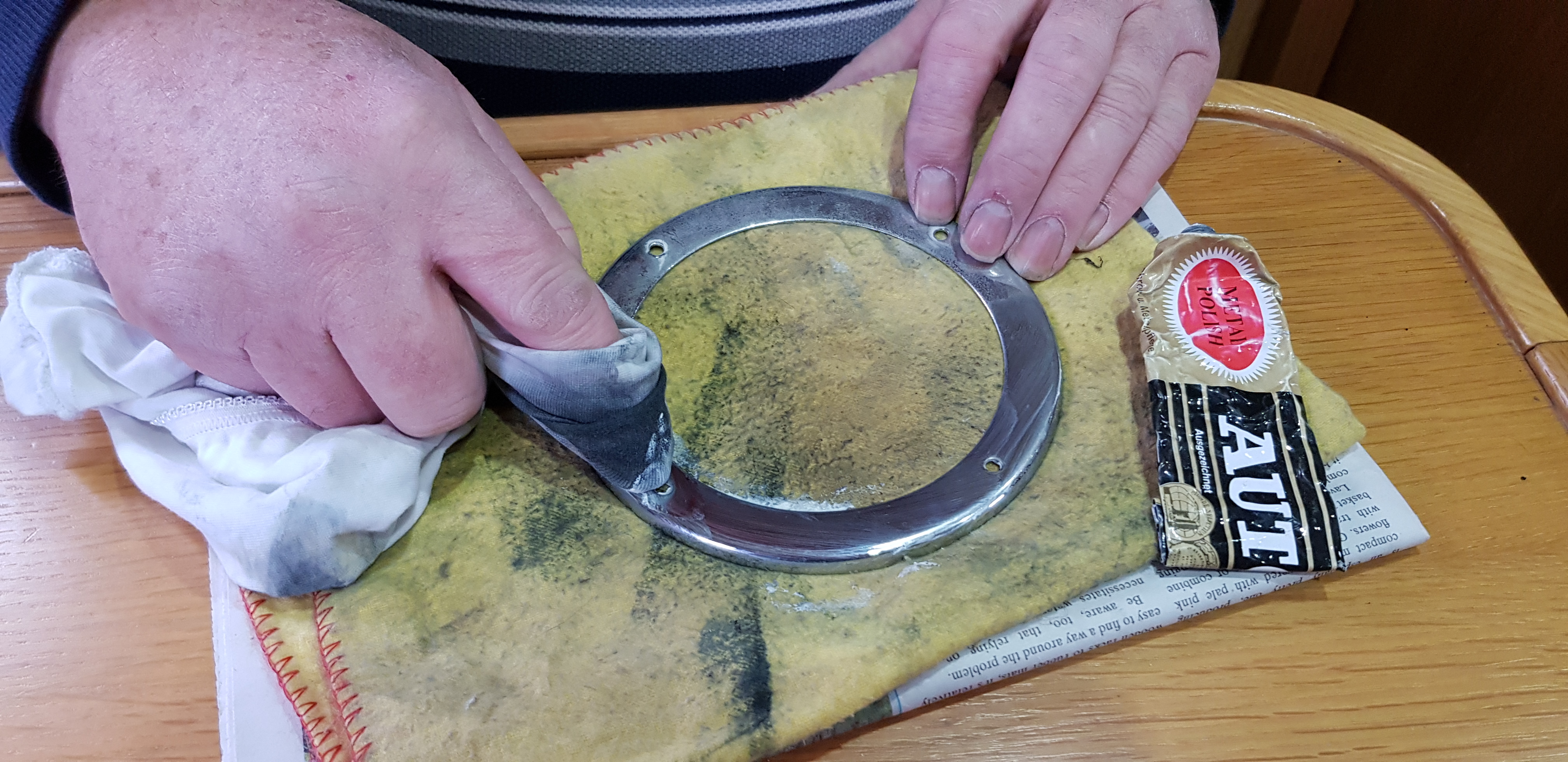

Here comer the fun part. We now take the sponge cloth of your choice and place the chrome Vent disk on the cloth. WIth a pen mark around the OUTSIDE of the disc.
We can now using a cup or mug create a hole in the centre of the outer ring, like this:-
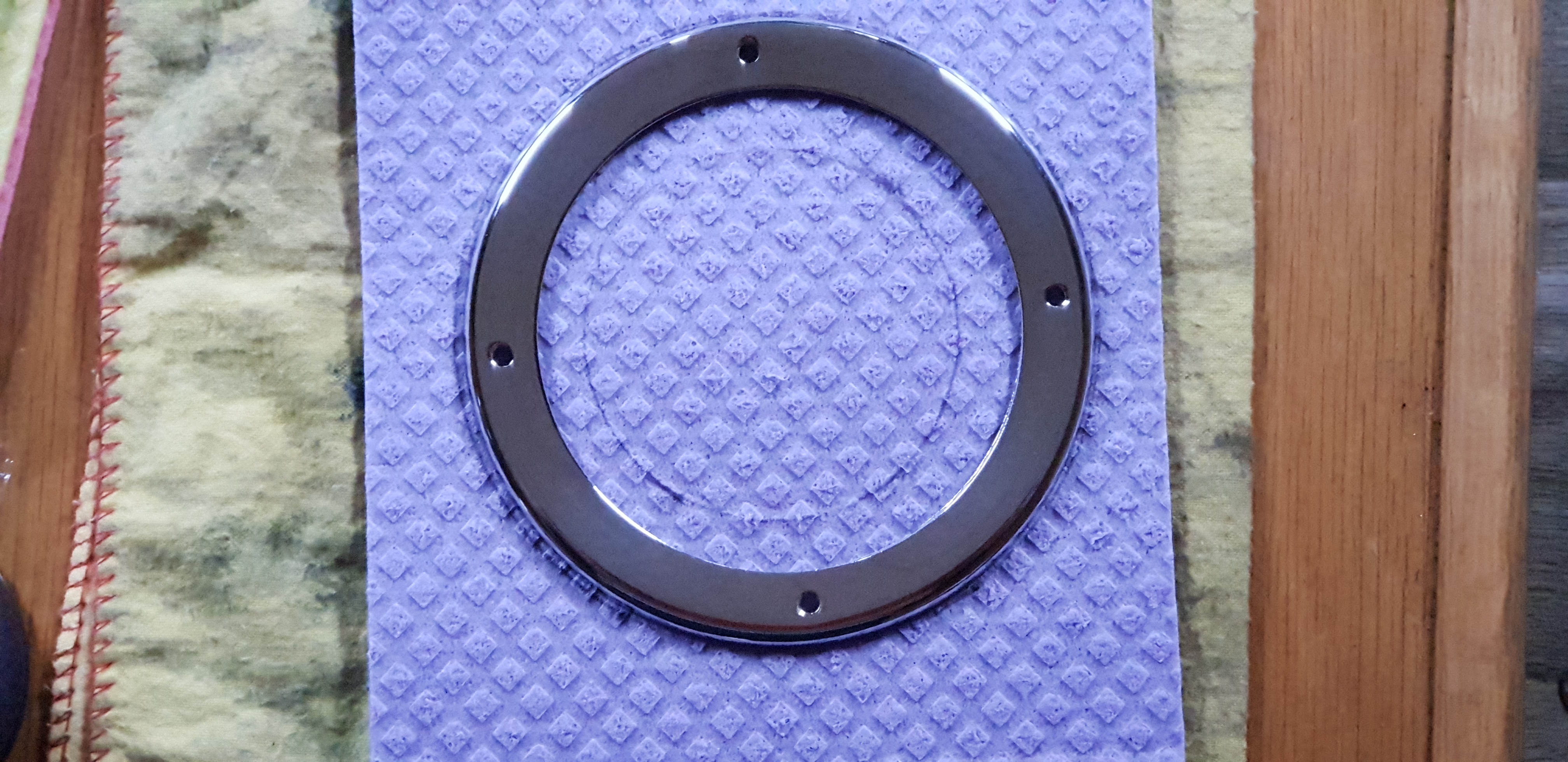

You are now left with a template. Cut out the cloth with a pair of sharp scissors, cut inside the line on the outer ring by about 2mm so that it will fit inside the Vent disc. You the cut the inner ring on the outside. You will now end up with a donut shape.


We can now re-fit the roof vent with the Donut behind the mesh, and in between the roof hole. The result is a nice disguised fitting.
I used a bradel to put hole through sponge then fitted alternate screws to bring into line. Ensure the Vent disc is covering the donut.

I have tested this system and you do not have to do anything. The sponge collects the condensation, then the sponge just dries out of its own accord.
There will be of course be a time they require cleaning, but being a sponge that is easy. The total cost for this venture was under £6.00 which is cheap to prevent more expensive damage, and also does not stop the roof vent from working as it should and does not breach the Boat Safety Certificate.
Please note this is a Canal Narrowboat copyright idea.
Boat Tip No 6
Bites from Bugs
 Great tip this. I have hate being molested by bugs when traveling on my narrowboat, especially Horse flies, Dear flies, and Cleggs. They all have a horrible after bite which is very painful due to the fact they inject into your skin an anesthetic, which allows them to feed on your blood. However this reacts after the bug has left with the skin.
They also attack from all angles especially Dear flies, which is not nice while you are on trying to concentrate on steering.
I have found the near solution. Boots Repel Maximum. It is a 125ml spray costing around £8.99. The stuff is absolutely magic and makes “Bad Blood” and they avoid you like the plague. Go here to Boots page.
Boots also do various other versions of this product, such a s roll-on.
The product contains 50% DEET so gives effective protection from mosquitoes for up to 5.5 hours (tropical and non-tropical) from one application*. Suitable for destination with a high to medium risk of mosquito borne diseases, such as malaria.

Boat Tip No 7
Spare Parts
It seems a bit of a simple tip this one but it can get you out of a load of trouble. I do belong to the River and Canal Rescue just in case of a major problem, but i always carry spares, such as a Fan Belt and two control morse cables. One for the throttle and the other the gear change. Good job i do as i had BOTH morse cables fail on me this season. They both broke at the control head end, in exactly the same place where the inner wire is crimped onto the adjuster section. So now i must replace those spares. I also carry 20 litres of diesel just in case, as have been to suppliers that have run out, or even closed down.
Boat Tip No 8
Winterisation of your narrowboat
Preparing your narrowboat for winter and likewise getting it ready for the new season is imperative to your craft’s longevity. In some cases, it will also help avoid damage to parts of your boat.
With winters getting colder each year and sub-zero temperatures becoming more common across the UK, here are some hints and tips on how to winterise your narrowboat and so avoid very costly repair bills.
For those living on their narrowboats it’s pretty much business as usual, although extra attention should be given to topping up antifreeze in keel cooling and other sealed water systems (such as radiators connected to the boiler). I also suggest doing an engine run every month, run the engine for an hour every month- this pushes oil around the engine and prevents rusting, plus it tops up the battery if left running long enough.
Lagging hot and cold pipes is also a good idea. However, if your narrowboat is being laid up for the winter, the ‘to do’ list is somewhat longer.
Service the engine and protect gear casing and generators
If not in use, store generators in a gas-tight locker – the same regulations as Liquid Petroleum Gas (LPG) apply here.
To keep water out of the engine and gear casing, fill the diesel tank to prevent condensation and add the correct ratio of fuel conditioner (available from most chandleries). I use Fuel Set Diesel Conditioner 1L
Used regularly, fuel conditioner increases performance, reduces emissions and improves fuel economy. It also removes water from fuel lines and tanks, prevents and dissolves fungal growth, dissolves deposits from the fuel system, injectors and carburettors and de-carbonises combustion chambers. I also have a fuel guard filter which also stops water coming in from the tank.
Carry out some simple narrowboat engine maintenance
If you’re nervous about leaving a full tank of diesel idle over the winter, as it may be a tempting target for thieves, ensure your engine has a water filter such as fuel guard – this’ll keep water out of the fuel line. However, I have fitted a full locking cap to my tank.
There are two types of diesel engine; air cooled and water cooled. Air cooled engines will not suffer ice problems, however water-cooled ones will if not properly treated. Ensure the right amount of anti-freeze is in the water-cooling system (if closed or keel cooling). If you have a raw water system, seal off the cock valve and if the engine is not to be used, drain the water out of the cooling jacket.
Also don’t forget to change the oil filters in the spring when the engine is serviced. Spray terminals with a silicone-free lubricant and grease all available grease points on the engine and drive, plus electrical connectors. Also lubricate linkages and gear/throttle slides.
Grease the stern tube once the engine is off – a vital link between propeller and engine. If not greased, water may dribble into the engine room, which over a long period of time can build up and cause your narrowboat to sink. As the boat gets lower in the water, any outlets such as those for a shower, sink or air vent, will get nearer to the water level and the result can be catastrophic. Grease the stern tube every time you turn off the engine as once the propeller turns, the seal is broken.
Draining water and heating systems
Burst water pipes can be a nightmare – yet easily avoided with some simple precautions;
Lag your hot and cold pipes and top up anti-freeze in keel cooling and other sealed heating systems (such as radiators connected to the boiler). This point is being repeated because it’s the single most important thing to do, whether your narrowboat is being used over the winter period or not.
Drain down the water system (including drinking water and cistern) and leave taps in the open position. Most water heaters have a screw plug at their base and most can accommodate an old-fashioned cycle pump which makes the emptying of water that much quicker.
Taps should be left open because if any water is left in the system and it freezes, the pressure on the pipes will be less due to air coming out of the taps.
Easy narrowboat security checks
Remove all valuable items such as electrical products, the television, even booze. If you have the luxury of a secure mooring this might not be such an issue, but if in doubt – take it out.
Invest in a decent lock – the chances are this will deter a thief and your insurance policy requires this. There are alarms on the market that generate a text to your mobile if activated, however, the general consensus appears they are costly and have limited effect.
Mushroom vents are becoming increasing popular amongst thieves so check your covers for water/gas heater exhausts or air ventilators have a bar across the bottom of their thread – this ensures they’re difficult to screw out.
To avoid discolouration, you may want to put grease on your external brass, as some narrowboat owners do. Remember to put away any spare ropes.
Maintain the fuel tank
Suppliers are likely to provide road diesel with a red marker dye which contains up to 7% biodiesel. One of the UK’s largest narrowboat and canal boat marinas, Trinity Marinas, says that because biodiesel is a solvent, it has concerns over the increased risk of bacterial contamination, including the oxidisation and precipitation of solids.
To combat this, the Leicestershire-based Trinity recommends a six month fuel turnover and reminds vessel owners to check the compatibility of this diesel with the fuel seals on older engines, fuel hoses and copper fuel lines.
If you have an older vessel it is suggested that replacing the fuel seals and fuel hoses as a precaution, examining the fuel systems after you’ve switched and replacing fuel filters after using two to three tanks of fuel.
Frequent checks of tanks will minimise water contamination, as will using a diesel bug treatment to break down the slimes and dead organisms (bacteria and fungi can enter the tank from the atmosphere via the vent or filling point).
Boat Tip No 9
De-winterisation
Owners who winterised their narrow boats properly will hopefully face few problems when taking to the water again when the season begins again. But before you get back on out on the water, consider the following advice;
Having drained down and switched off water systems, removed the water heater screw plug and left the taps in the open position, it’s now time to turn off the taps, replace the plug and switch the water pump on.
Once the water pump is back on, go to each tap in turn and run water through it. Start with the taps closest to the pump and work your way through to the one furthest away – this’ll push out any air locks. Drain any water in the tank out and refill before drinking.
Also remember servicing, including the engine, LPG and electrical systems, plus fire extinguishers and escape hatches. Everything should pass Boat Safety Scheme scrutiny.
Although no action is needed for the gas pipes at the start of the winter, it’s a good idea to paint connections with 50% soap liquid and 50% water using a small artist’s brush – this will show up any minor gas leaks at the joints.
In many cases, problems arise as a result of something that has simply been overlooked and left to cause greater problems. For example, faulty gas fittings and issues with inverters/generators make narrow boats more vulnerable to serious fire. Surprisingly some boats even sink due to weed hatches being incorrectly fitted after cleaning, allowing water to seep back into the craft.