
Pumps, there are three types of pump onboard most narrow and wide beam boats. This also applies to bigger other craft such as large Thames River cruisers and sea going craft.
They are
- Bilge Pump
- Fresh or Potable water pump
- Waste water pump
Bilge
A good bilge pump is an essential on any boat and can save you thousands of pounds. If in the event of a leaking skin fitting, grease gland or burst internal pipe, the pump will pump out excess water.
It will also help to stop you boat sinking.
The earliest bilge pump was a bucket, but not for todays modern boater.
The boats bilge is the lowest area in the boat. That is the whole area directly above the base plate from bow to stern and below sub floors and the engine.
Some folks usually refer to the area directly underneath the propeller shaft in the stern, but it is important to remember the cabin bilge.
Where do you place bilge pumps
A Bilge pumps should be fitted wherever the total bilge area is divided by a solid bulkhead. A bulk head is a large metal wall across the structure of the boat from the base plate, to both sides of the boat. (This is not internal wooden walls).
During cold weather , an accumulation of water in the engine compartment and main hull can come from condensation, or a poorly sealed weed hatch, a leaking cooling system, rainwater and, importantly, from the propeller shaft outlet (stern gland).
Water in the cabin bilge can come from condensation, leaking water pipes, and pumps, bath, sink and shower outlets or even leaking windows.
In general Narrowboats are designed so that the stern of the boat is lower than the bow. This helps any water that gets into the cabin bilge to drain down towards the rear or stern.
Some boats have an open bilge that runs straight into the engine bay. Others have a wooden, now usually steel, bulkheads that separates the cabin bilge from the engine bilge.
If your boat has a separate cabin and engine bilge you should ideally install a bilge pump in the cabin bilge against the rearmost lowest bulkhead, plus one in the engine compartment.
Bilge pumps in the engine compartment are usually sited under the propeller shaft. This area is called the bund. It is quite likely that this bund, or contained area, is separated from the area under the engine by a small steel plate. This ensures that no oil mixes with the bilge water. This also stops any water dripping from the stern gland, is contained in the bunded area and collected by the bilge pump rather than flowing into and across across the engine bay.
The other thing to consider is cleaning out your deck board channels and drains. If they get blocked the rain will flow into your engine bay and the bilge.
What to fit? automatic electric, manual electric, or hand pump
There are many types of bilge pump available from most good chandlers. The very basic type of pump is hand operated. Electrically operated bilge pumps require either a manual switch to operate or are fully automatic. As a point of rule always go for fully automatic.
Always follow the manufacturers guidance for installation. It is essential you pay attention to the power rating of the pump, also the rating of the outside cable insulation as bilges are harsh places. Also ensure that you provide a fused circuit with the manufactures rating. Most are 15 amp
If the pump is automatic, i.e it uses a float or sonic sensor to activate the motor, then wire it so that it is always on. There is no point in having an automatic pump that does work when you are not there! Sods Law is that the leak will happen when you are not there, so you need your bilge pump to work when you’re not aboard, or notice there is a problem.
As matter of thought, bypassing of battery isolation switches by bilge pump installations is one of the few allowable exceptions of the Boat Safety Scheme. It makes sense that either the manual switch or the pump itself can be operated if the batteries have been isolated from the main engine or domestic systems.
With hand pumps, these really are a back up system if say the electrical supply is compromised, or say in a dingy.
Here is a good bilge pump video
Fresh Water or Potable
The size and shape of your vessel, and the number of water outlets you require, will determine the size of the pump.
Other things to consider, are accumulators and strainers, however there some pumps that now do not need an accumulator.
The fresh water pumps normally come in 12v or 24v ratings. Ensure which one you will require.
The next thing is flow and pressure. This will dictate how many outlets at the same time the pump will serve. I prefer to have a least four.
In having a four will ensure say, if you are having a shower, and someone want water from a tap, it will be able to give adequate supply.
You will find most pumps these days are pressure controlled. The pump has a senor which know when to turn on the pump and when to turn it off. You will find that these pressures are set by the manufacture to suit the pump. To give you an idea a Jabasco 31295-0094 Par Max 1.9‘ pressure-controlled pump the pressure switch – cuts in at 1.0bar (15psi) – cuts out at 1.7bar (25psi)
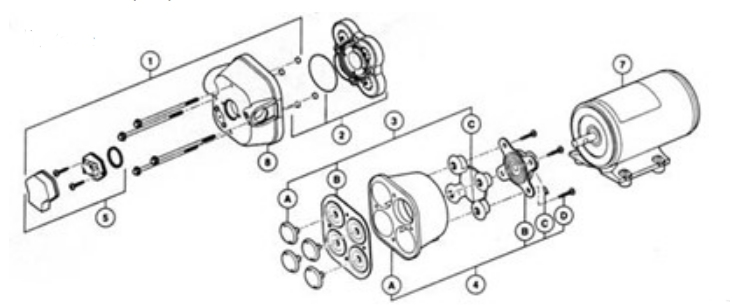
Most of the pumps these days are diaphragm pumps. The smaller ratings have three, while the larger versions four. These compact diaphragm pumps have smooth flow characteristics, are self priming and, can run dry.
When you purchase your pump is is also wise to see if you can service the pump yourself. Some companies do not supply this option.
Here is a break down of a fresh water pump with FOUR diaphragms
There are few things that can indicate that you have a leak with pressure pumps. If the pump starts to run for short periods, like in the night, it can give you a good indication that there is a leak on your system.
The leak may also be seals on the head of the pump itself, they do go after a few years. This is easily checked as it will be wet around the pump body.
However, if all is dry at the pump and the taps are not leaking then water must be being lost at a joint somewhere on your boat.
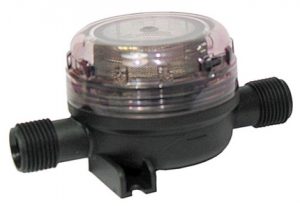
Mesh filters or strainers which connect directly to the inlet port of the pump are often required for warranty from the manufacturer. Just fit one, they will protect your expensive pump from damage from any large foreign objects that may have fallen into the tank.
Waste Water
When you are looking at Narrowboats, waste water from sinks that are higher than the water line, go through pipework that is directly connected to through hull fittings. These empty under gravity. However watch the distance they are above waterline. You must ensure they are 4inch above or have sea cocks (a tap) in line.
Washing machines have their own built in pumps, and can pump out with out a problem. Fittings that service your waste water below the water line such as baths and shower outlets, a pump is definitely required to extract the water.
There are many problems associated with pumping water uphill. They are mainly related to gravity and the weight of water.
To do this we need to specify a pump that can cope with the vertical lift. There are some very good units, available from good chandleries.
Because these pumps clear water from waste pipes, they suck air on the last few cycles and are designed to run dry.
The pumps have heavy duty motors which are designed to give you a long service life. The strong internal construction means they can cope with the mixture of hair and soap waste from showers and baths. You have to bear in mind that your installation should be referenced to the manufacturers instructions, with an eye on your warranty, wiring and plumbing connections.
When fitting ensure you have very good access to your pump for future inspection or removal and that the pump has a good air supply to prevent overheating.
There are two types of waste water pumps:
- In-line diaphragm pump or gulper
- Sump Pump
With the conventional gulper pump you have to turn it on and off manually.
The sump pump is activated by a small float in a water container box that rises as water flows into the box. Making it an automatic operation. However if the float sticks then you get an over flow of the water container, which is not nice. Therefore regularly inspect the box is imperative to remove any obstructions or build ups of hair. With some of your pumps, they are fitted with a strainer which you have to empty as well.

There are however pumps that do not need a strainer. These are a single diaphragm which flips back and forth the extract the water.
I have noticed with these that if and large gritty bits go through the pump, it will stop the diaphragm. However this is a rear thing and if you keep this in mind when using you will get a lot of service out of them. The one pictured is a Jabsco Self-priming diaphragm pump 12 volt d.c.